"If code has not been reviewed for security holes, the likelihood that the application has problems is virtually 100%."
This is a shrewd message on the first pages of the OWASP Code Review Guide. An organization that does not put the code it uses and develops under review is irresponsible with its assets and those of its customers or users.
Security problems in its products can be exploited by cybercriminals, leading to data breaches or disruption of operations and consequent fines and loss of clients and reputation. To help prevent all of this, it's prudent to match software development from the outset with a secure code review.
What is secure code review?
Secure code review is the examination of an application's source code to identify security flaws before the software reaches production. It combines automated analysis with manual inspection by security experts, and the manual half is what finds the flaws scanners cannot see. In Fluid Attacks' tool benchmark, run against a web application containing 1,201 vulnerabilities, one pentester found 1,076 of them — 89.6% recall with 100% precision and zero false positives — while the best-scoring scanner in the study reached 22.7% recall.
Secure code review can take place at any point in the software development lifecycle (SDLC), but within the DevSecOps culture, it is most valuable to use it from the early stages.
Code review vs. secure code review
A standard code review asks whether the code works and reads well. A secure code review asks whether an attacker can abuse it. The two run on different checklists and usually involve different people.
Feature | Code review | Secure code review |
|---|---|---|
Primary purpose | Improve overall code quality, maintainability, style, and functional correctness. | Identify and mitigate security vulnerabilities and ensure adherence to security standards. |
Primary focus | Readability, adherence to style guides, design patterns, and bug detection. | Input validation, authentication and authorization flaws, data leakage, business logic errors, and configuration issues. |
Key participants | Developers, QA team members. | Developers, security experts, and specialized security teams. |
Secure code review ensures that security is treated as a core property of code quality, preventing the introduction of weaknesses that could otherwise compromise data or functionality.
How does the secure code review work?
A secure code review works best as a blend of manual and automated inspection, because each one covers the other's blind spot. The automated review (like SAST) provides speed and breadth. The manual review provides depth and accuracy.
The manual secure code review is conducted with great attention to detail. One or more security analysts scrutinize code, understanding what they are evaluating, keeping in mind its use and context, the developers' intentions, and the business logic.
The automated secure code review examines more code in less time, but it does not consider those factors. The tools work with a predefined set of rules, are restricted to certain types of vulnerabilities, and suffer, some more than others, from reporting false positives (i.e., saying that something is a vulnerability when it is not).
Automated tools, with their quick and initial assessment, act as an assistant to the human reviewer, making it easier for security analysts to focus on identifying more complex and business-critical vulnerabilities.
Among the most commonly used methods in automated secure code review are Static Application Security Testing (SAST) and Software Composition Analysis (SCA; understand how one differs from the other in this blog post).
Feature | Automated review | Manual review |
|---|---|---|
Primary method | High-speed, automated pattern matching. | Strategic, human-driven analysis. |
Context/Intent | Limited to code structure; lacks runtime or business context. | Deep understanding of application architecture, context, and business intent. |
Key value | Breadth: catching high-volume, common, syntactic flaws early (e.g., SQLi, XSS). | Depth: finding complex business logic flaws, state errors, and architectural security anti-patterns. |
Application | Pre-review scanning (pre-commit/PR) for rapid feedback in the IDE/CI pipeline. | Triage of automated findings and deep dives into critical components (e.g., authorization logic). |
How to conduct a secure code review?
A professional secure code review follows four stages: scope the review by risk, run tools first, dig in by hand, then report and verify the fix. Each stage feeds the next.
1. Planning and scope definition
The process begins by defining the scope. Since secure code review is time-consuming, it is essential to prioritize the review based on risk. This involves:
Defining clear objectives: What types of vulnerabilities are we trying to detect (e.g., compliance with PCI DSS, or flaws in a new authentication feature)?
Gathering context: Understanding the application's architecture, business requirements, and functionality; gathering threat models and previous security findings.
Prioritizing code: Focusing on critical assets and high-risk functions such as authentication modules, payment processing, access controls, and new features.
2. Tool-augmented execution
The human review is supported by technology to increase efficiency:
Pre-review scanning: Run automated tools (SAST/SCA) first to rapidly detect known security issues in the code baseline and third-party components.
Triage: Use the automated findings to filter false positives and guide the deeper manual investigation to specific, high-risk code paths.
Manual analysis techniques: The reviewer uses techniques like code path tracing (following execution paths) and trust boundary mapping (analyzing security control points) to apply their domain expertise.
3. Deep dive and checklist validation
The core of secure code review involves a detailed, line-by-line review, with a focus on areas that require contextual and business logic understanding. During this phase, the expert reviewer applies standardized security checklists (often based on OWASP, CWE, or internal policies) to ensure a systematic examination of key categories like input validation, authentication, and access control.
4. Reporting, remediation, and verification
Findings are documented with precise details, including:
Vulnerability description: A clear explanation of the flaw and its security mapping.
Exploitability and impact: An assessment of the risk level (using a standardized framework) to aid in prioritization.
Precise location: File name and line number, confirmed by human validation.
Detailed proof of concept: A step-by-step demonstration of how the vulnerability can be exploited, to facilitate developer understanding.
Remediation guidance: Specific, secure code suggestions for developers.
After remediation, a follow-up review must be conducted to verify that the fix eliminated the vulnerability and did not introduce new flaws.
The human advantage: what experts look for
Experts find what scanners structurally cannot: flaws that depend on business context rather than on code patterns. In Fluid Attacks' State of Attacks 2025 report, which covers testing performed throughout 2024, 71% of the total risk exposure in the assessed systems was reported by the manual method, and almost 99% of critical-severity vulnerabilities were detected by our pentesters rather than by our tools.
This is not an argument against automation. It is an argument for pairing it with human verification, as Kevin Cardona, security analyst at Fluid Attacks, put it in his analysis of static testing:
"Reports should always be checked by experts because automated tools tend to notify large numbers of false positives should be discarded to know the actual risks of an application."
Go deeper: What is manual code review? and Our DevSecOps tools, where we describe how our analysts run manual SAST alongside the scanner to find more complex, perhaps zero-day, vulnerabilities.
The review focuses on critical areas such as the following.
Business logic flows
The reviewer analyzes the application's unique processes to look for:
Workflow integrity: Opportunities to bypass state transitions, steps, or validation in multi-step processes.
Race conditions: Timing-based vulnerabilities in concurrent operations where multiple users interact with the same resource.
Resource limits: Ensuring rate limiting and resource quotas are implemented to prevent denial of service or resource exhaustion.
Authorization and access control
The reviewer checks the correctness and completeness of security enforcement:
Server-side enforcement: Verifying that all access controls are enforced on the server, not just on the client side.
Fail-safe defaults: Ensuring a default deny access policy is used.
IDOR prevention: Checking for Insecure Direct Object References where a user can manipulate a parameter (e.g., an ID) to access another user's data or unauthorized resources.
Missing authorization is catalogued by MITRE as CWE-862, one of the weaknesses that automated pattern matching most often misses, because deciding who should be allowed to do something is a business question, not a syntactic one.
Input validation and output encoding
While SAST can find basic injection patterns, the expert ensures contextual correctness:
Server-side validation: All user and external input is validated regardless of client-side checks.
Allowlist validation: Using allowlists (accepting only known good input) rather than blocklists (rejecting known bad input).
Context-appropriate encoding: Ensuring data is properly encoded (HTML, JavaScript, URL, SQL) before output to prevent injection attacks like XSS or SQL injection.
Cryptography and secrets management
Strong algorithms and key management: Verifying the use of modern, tested algorithms (e.g., AES-256, RSA-2048+) and secure key generation, storage, and rotation.
Hardcoded secrets: Identifying where a developer left confidential information (e.g., API keys, tokens, credentials) inside the code, including configuration files.
Secure code review tools
Two tool families cover the automated half of a secure code review, and they look at different things: SAST reads your code, SCA reads what your code imports.
SAST tools automatically scan the source code or object code of applications —while these are not running— to detect vulnerabilities that match those stored in databases.
SCA tools automatically scan applications to inventory their third-party software components and their dependencies, and identify vulnerabilities in them that coincide with those registered in databases.
Neither family is self-sufficient. Commercial SAST tools are known for high false positive rates, so their output has to pass through someone who can tell a real issue from noise before it reaches a developer. We break down where each method's blind spots fall in How do SAST, SCA and DAST differ?
How accurate can the automated half get?
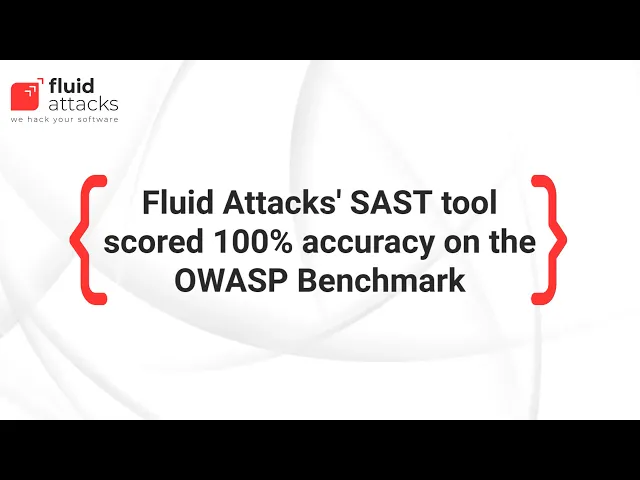
Very accurate, on the problems it is built for. Against the OWASP Benchmark v1.2 — a public suite of 2,740 synthetic Java test cases with a known answer key — Fluid Attacks' scanner reached a 100% true positive rate and a 0% false positive rate, for the maximum benchmark score of 100.
▶️ Watch: In this video, we walk through how our scanner is measured against the OWASP Benchmark and how anyone can reproduce the result.
That score deserves its context, and the context is the argument for keeping humans in the review. The OWASP Benchmark measures injection-style weaknesses in synthetic code where the correct answer is already known. It contains no bypassable checkout flow, no race condition between two concurrent users, and no authorization check that is correct in isolation and wrong for a particular business. A perfect score on a pattern-matching test is a perfect score on pattern matching, which is why our analysts read the code as well.
Secure code review vs. application security testing
Application security testing (AST) is a broader concept than secure code review; the latter is part of the former. AST, apart from SAST and SCA, involves assessment methods such as Dynamic Application Security Testing (DAST), Pentesting as a Service (PTaaS), and Reverse Engineering.
While secure code review can be applied at any stage of software development, DAST and PTaaS are generally employed when the application can run, in order to evaluate its behavior through attack vectors. Secure code review is a foundational element that, combined with DAST (which checks for runtime and configuration errors) and PTaaS, gives a defense-in-depth approach to security.
When should you implement secure code review?
From the first lines of code, and continuously after that. Applying this method as soon as the first commits land makes it possible to identify and remediate vulnerabilities before they reach production, which is both cheaper and faster than fixing them later.
This is not only good practice; it is a codified one. NIST's Secure Software Development Framework (SP 800-218, v1.1, 2022) lists practice PW.7, "Review and/or Analyze Human-Readable Code," as a required activity for identifying vulnerabilities and verifying compliance with security requirements, and it explicitly names both peer review and automated analysis as ways to do it.
A holistic strategy involves two timing strategies:
Continuous review: Implementing automated tools in integrated development environments (IDEs) and during pull requests is the most impactful way to shift security left. Developers receive near real-time feedback and fix issues while the code is fresh in mind.
Targeted review: Reserving an exhaustive manual code review for strategic points in the SDLC: project initiation (comprehensive assessment of a new or legacy codebase), major releases, architecture changes, and compliance cycles (PCI DSS, HIPAA).
Why is secure code review important?
Because developers are not usually taught application security, and even experienced ones introduce vulnerabilities. Secure code review is the control that catches those mistakes before an attacker does.
Security in general, and common weaknesses in software and their exploitation, are not usually taught to developers in their academies and workplaces. And even the most experienced developers, due to factors such as burnout or carelessness, can make coding mistakes and end up generating vulnerabilities such as those listed in the OWASP Top 10 and CWE Top 25. For reasons such as these, source code should remain under review by security experts.
Detection of vulnerabilities in source code and components
Secure code review identifies the absence of safe coding practices, lack of appropriate security controls, and violation of compliance standards such as PCI DSS and HIPAA. Reviewers may find missing or erroneous validation of inputs coming from the different sources that interact with the application (e.g., users, files, data feeds). They may discover confidential information (e.g., tokens, credentials) left inside the code. They may see that information that needs to be stored and transferred doesn't pass through proper encryption algorithms. They may find that user authentication processes are weak, requiring, for example, short passwords with little variety in their characters, and that authorization controls end up giving unnecessary access to any user.
An important issue often discovered with secure code review, using SCA tools, is vulnerabilities within third-party and open-source components. Application development today heavily depends on open-source components, imported from various sources, which also depend on each other. So when using one of them, the developer may not be aware of its relation to the others. Cybercriminals have these dependencies among their desired targets.
Application of best coding practices
The experts and tools responsible for a secure code review verify whether the developers of the software under evaluation have been employing secure coding practices. Two of our blog posts deal more extensively with this ("Go Over and Practice Secure Coding" and "Secure Coding in Five Steps?"). Here are some of those practices that should always be a point of reference for code development and review. Ensure that your software:
Validates inputs from untrusted sources and accepts only those that meet specific characteristics.
Verifies the identity of users or entities seeking access to private resources and, in critical operations, requests multi-factor authentication.
Requires users to create sufficiently complex passwords.
Restricts access to specific high-value resources to only a few authorized users.
Gives users access by default only to the resources needed to accomplish certain tasks.
Establishes relatively short session inactivity timeouts.
Uses well-known, tested, and up-to-date encryption algorithms for sensitive information in transit and at rest.
Does not hold sensitive data such as comments within its code.
Does not reveal valuable information to attackers in error messages resulting from invalid activities.
Keeps all third-party components updated to their latest versions.
For more information, you can also check OWASP recommendations for developers on their Code Review Guide.
Other benefits of secure code reviews
Cost efficiency
Secure code review reduces the number of vulnerabilities found in the final stages of the SDLC, through procedures such as pentesting. Therefore, the time developers spend on remediation in those stages goes down too. Fixing a large number of vulnerabilities shortly before going into production becomes a thorn in the developers' side.
It is easier and less expensive to do code fixes in the development environment than in production. With a continuous secure code review, you are closer to the cause of the problem and can fix it immediately, avoiding any buildup.
Fostering a security culture
Thanks to an early secure code review, developers can start to assume a commitment not only to remedy the security issues identified in their products but also to make their results better every day. Certain groups of developers, with the help of the security teams and their reviews, can pass on knowledge, inspire others to improve their practices, and make the transition to a mindset in which everyone in the organization is responsible for security.
The feedback loop helps developers learn from the patterns and practices that led to the error. Those security missteps that so often give rise to vulnerabilities become less frequent over time.
Compliance and reputation
Organizations that implement secure code review in their software development processes recognize the responsibility to comply with established standards in their industries. They seek to offer products and services that guarantee security for their operations, data, and other resources, mainly those of their customers or users. This generates trust and reflects commitment and quality, positively affecting their competitiveness and reputation.
Secure code review at Fluid Attacks
We review only the code we are authorized to review. Every engagement runs under a written agreement that defines the repositories in scope, and our analysts work from your own repositories without extracting code outside that scope. Secure code review is one method inside our all-in-one AppSec offering, and it runs in the Advanced plan alongside SAST, SCA, DAST, PTaaS, and Reverse Engineering.
What the manual half adds
The case for keeping humans in a code review is measurable, not rhetorical. In our tool benchmark, we ran 36 third-party tools, our own scanner and one of our pentesters against a single web application containing 1,201 vulnerabilities across 105 CWE categories, and scored them on both vulnerability count and risk exposure (CVSSF).
Evaluator | Precision | Recall (vulnerabilities) | Recall (risk exposure) |
|---|---|---|---|
Fluid Attacks' pentester | 100% | 89.6% | 98.9% |
Fluid Attacks' scanner | 99% | 22.7% | 8.8% |
Best third-party tool in the study | 72% | 21.6% | 4.0% |
Average of the other 34 third-party tools | — | 1.7% | — |
The number that matters most is not in the table: 743 of the 1,201 vulnerabilities, or 61.9%, were found only by the pentester, and they carried 86.8% of the application's total risk exposure. Seventeen of the tools failed to identify even ten vulnerabilities.
The trade-off is time. The pentester took 49 days; the automated tools averaged just over 44 minutes. That is precisely why we run both halves rather than choosing one.
Our reviewers are certified pentesters. The team holds more than 60 distinct international certifications, among them OSWE (OffSec Web Expert), which is built specifically around finding vulnerabilities by reading source code, plus OSCP, OSEP, eWPTX, HTB-CWEE and BSCP. The team also competes in the HTB Business CTF to keep those skills sharp against live targets.
How a finding reaches you
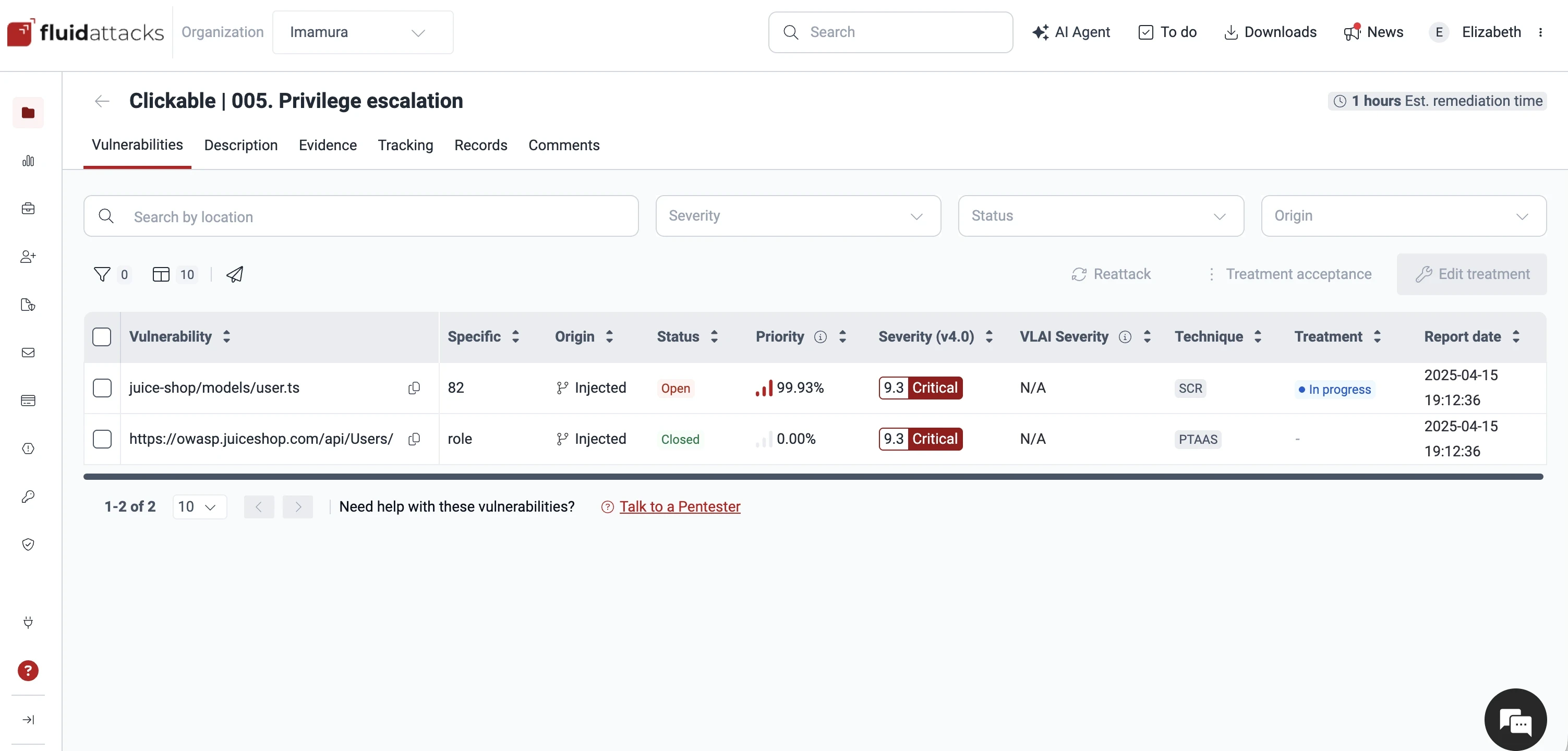
A privilege escalation reported in the Fluid Attacks platform. The Technique column marks it as SCR — found by secure code review — with the exact file and line, a CVSS v4.0 base score of 9.3, and its remediation status.
Every finding we report is typed against our own public criteria, so you can audit what we called it and why. The privilege escalation above maps to weakness 005 in our Vulnerability Database, which carries its description, impact, recommendation, expected remediation time and fixes by programming language. That weakness in turn maps to security requirement 035, which is itself mapped to CWE-267, CWE-269, CWE-639 and CWE-862, OWASP Top 10 A1, PCI DSS 7.2.3, ISO/IEC 27001 8.2 and NIST CSF PR_AA-01, among more than 60 international security standards. None of this is behind a login: the database is public.
Our secure code review supports many programming languages, including C, C#, C++, HTML, Java, JavaScript, PHP, Python, Ruby, and Swift, and we adjust to requirements specific to your application and business logic.
We integrate our CI Gate into your pipelines to break the build when there are policy violations and open vulnerabilities. In State of Attacks 2025, systems that broke the build reached a 62.4% remediation rate, against 31.5% for systems that did not. We report everything on our platform, where you can analyze your security issues, receive recommendations and manage remediation. Your developers can also use our IDE extensions for faster recognition of affected lines of code and GenAI-based remediation suggestions. All this is part of our all-in-one solution, which also integrates security testing methods for running applications.
How to choose your secure code review team?
Look for certified experts, low false positive and false negative rates, broad language coverage, and a single dashboard that prioritizes remediation. Developers can peer review each other's builds for logic or style, but security issues call for specialists.
Security engineers, code reviewers, and pentesters specialize in identifying vulnerabilities. They bring a broader perspective and a threat modeling mindset to spot subtle, structural security flaws that a developer might overlook. Reviews by an external agent can also ensure that all flaws are reported while maintaining an unbiased view.
Their assessments should be able to be performed in a broad range of programming languages, be based on multiple international security standards, and report findings on a single dashboard that prioritizes, encourages, and facilitates remediation.
Conclusions
Secure code review is the cheapest place to remove an exploitable flaw, and the only application security method that reads intent as well as syntax. Automated tools give it breadth; experts give it the context that decides whether a code path is actually abusable. Fluid Attacks' own numbers put that split at 71% of risk exposure reported manually and almost 99% of critical-severity findings, which is why we run both halves continuously rather than as a pre-release gate.
Frequently asked questions
What is the difference between code review and secure code review?
A code review looks for defects in quality, style and functional correctness; a secure code review looks for flaws an attacker can exploit. They use different checklists and usually involve different people — developers and QA for the first, security experts for the second.
Can secure code review be fully automated?
No. Automated tools cover breadth, not depth. In Fluid Attacks' tool benchmark against a web application containing 1,201 vulnerabilities, one pentester reached 89.6% recall with 100% precision, while the best-scoring scanner reached 22.7% recall and only 8.8% of the application's risk exposure. Business logic flaws, authorization errors and misused cryptography depend on context that pattern matching does not have.
Does Fluid Attacks perform manual secure code review?
Yes. Certified pentesters review your source code alongside our own SAST and SCA scanners, under a written agreement that defines the repositories in scope. Findings are reported in our platform with the affected file and line, a CVSS v4.0 score, and a link to the matching entry in our public Vulnerability Database.
When in the SDLC should secure code review happen?
From the first commits, and continuously after that. NIST's Secure Software Development Framework (SP 800-218) lists code review as practice PW.7 and names both peer review and automated analysis as valid ways to perform it. Fixing a flaw in development is cheaper and faster than fixing it in production.
What vulnerabilities does manual secure code review find that scanners miss?
Mainly the ones that depend on business context. Bypassable multi-step workflows, race conditions, missing authorization checks (CWE-862), insecure direct object references, misused or outdated cryptography, and hardcoded secrets in configuration files. A scanner can flag a pattern; it cannot decide whether a given user should be allowed to reach a given resource.
Fix it before it ships
Our pentesters and scanners review your source code from the first commit, so vulnerabilities get fixed while they are still cheap. Start free trial · Contact us.