Pimcore Platform v12.3.3 - SQL Injection in DataObject composite index handling
7
High
Detected by

Fluid Attacks AI SAST Scanner
Disclosed by
Oscar Naveda
Summary
Full name
Pimcore Platform v12.3.3 - SQL Injection in DataObject composite index handling during class definition import/save
Code name
State
Public
Release date
Affected product
Pimcore
Vendor
Pimcore
Affected version(s)
12.3.3
Fixed version(s)
Commit: a6964b0982100ee225beb7c1c9ef01ed1a98d47c
Vulnerability name
Blind-based SQL injection
Vulnerability type
Remotely exploitable
Yes
CVSS v4.0 vector string
CVSS:4.0/AV:N/AC:L/AT:N/PR:H/UI:N/VC:H/VI:L/VA:L/SC:N/SI:N/SA:N
CVSS v4.0 base score
7.0
Exploit available
Yes
CVE ID(s)
Description
An authenticated administrative user who can import or save DataObject class definitions can inject attacker-controlled composite index metadata and trigger unintended SQL execution in the backend.
The vulnerable flow accepts compositeIndices from imported JSON, stores the values without strict validation, and later concatenates them directly into ALTER TABLE ... DROP INDEX and ALTER TABLE ... ADD INDEX statements executed through Doctrine DBAL.
Although the original report focused on compositeIndices.index_key, independent code review shows that the strongest and most reliable injection point is compositeIndices.index_columns, because it is inserted verbatim inside the ADD INDEX (...) clause. This permits the injection of additional ALTER TABLE subclauses against Pimcore object tables without relying on stacked queries.
Vulnerability
Root cause
Source:
Pimcore\Model\DataObject\ClassDefinition\Service::importClassDefinitionFromJson()acceptscompositeIndicesdirectly from imported JSON.
Assignment:
Pimcore\Model\DataObject\ClassDefinition::setCompositeIndices()does not enforce an allowlist for index names or column names.The only special handling is a ManyToOne relation rewrite to
__idand__type, which is not a security control.
Sink:
Pimcore\Model\DataObject\Traits\CompositeIndexTrait::updateCompositeIndices()builds raw SQL with string concatenation and executes it via$this->db->executeQuery(...).
Missing protection:
quoteIdentifier()is used for theSHOW INDEXESquery, but not for the dynamicALTER TABLEstatements.No server-side schema validation restricts
index_keyorindex_columnsto known safe identifier characters.
Confirmed source-to-sink path
importClassDefinitionFromJson()decodes attacker-controlled JSON and forwardscompositeIndices.setCompositeIndices()stores those values without sanitizing identifier content.ClassDefinition::save()reachesClassDefinition\Dao::update().Dao::update()callsupdateCompositeIndices()for:object_store_<classId>object_query_<classId>
Localizedfield\Daoalso callsupdateCompositeIndices()for:localized query tables
localized store tables
The vulnerable ADD INDEX statement is built as:
$columnName is produced from implode(',', $columns) and is not quoted or validated. A malicious index_columns element such as:
produces SQL of the form:
This remains a single ALTER TABLE statement, so the base vulnerability does not depend on multi-statement support. The attacker can inject additional DDL clauses affecting the target Pimcore object table.
Impact
The issue allows a privileged attacker to alter backend SQL behavior during class-definition import/save and modify schema on Pimcore object tables associated with the affected class.
Practical impact includes:
Unauthorized schema modification on object query/store tables
Backend denial of service by breaking the expected table layout
Data integrity impact for DataObject storage and queries
index_key is also concatenated into SQL without proper identifier escaping, but the most defensible exploitation path is through index_columns.
Relevant code:
models/DataObject/ClassDefinition/Service.php:92-137models/DataObject/ClassDefinition.php:994-1006models/DataObject/Traits/CompositeIndexTrait.php:30-85models/DataObject/ClassDefinition/Dao.php:217-218models/DataObject/Localizedfield/Dao.php:945-951
PoC
Application-level PoC
Preconditions:
Valid authenticated administrative session.
Ability to import or save a class definition containing
compositeIndices.
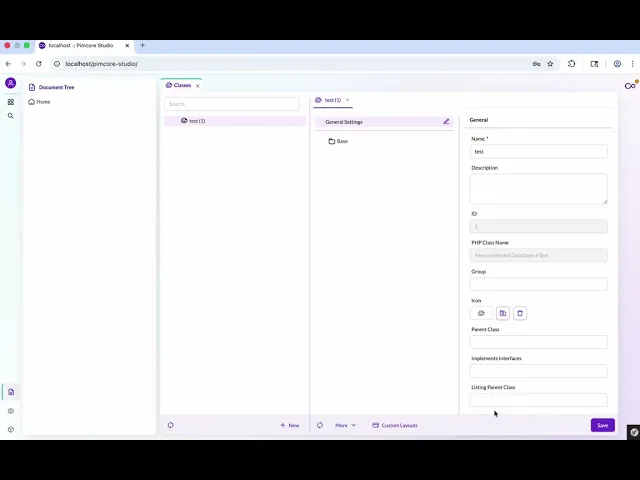
The original report reproduced the issue through an authenticated Studio endpoint:
Minimal malicious JSON fragment:
Reproduction:
Authenticate as an administrator with permission to manage/import class definitions.
Export an existing class definition or prepare a valid class-definition JSON document.
Replace only the
compositeIndicessection with the payload above.Import the modified definition or save the class through the administrative workflow.
Expected result:
Pimcore reaches
updateCompositeIndices()during class save/import.The backend executes an attacker-influenced
ALTER TABLEstatement against the target object table.The affected class table is modified unexpectedly, for example, by dropping a column or otherwise changing the schema.
Minimal source-level confirmation
The behavior is directly visible from the code path:
No escaping or allowlist validation is applied $columns before they are interpolated into SQL.
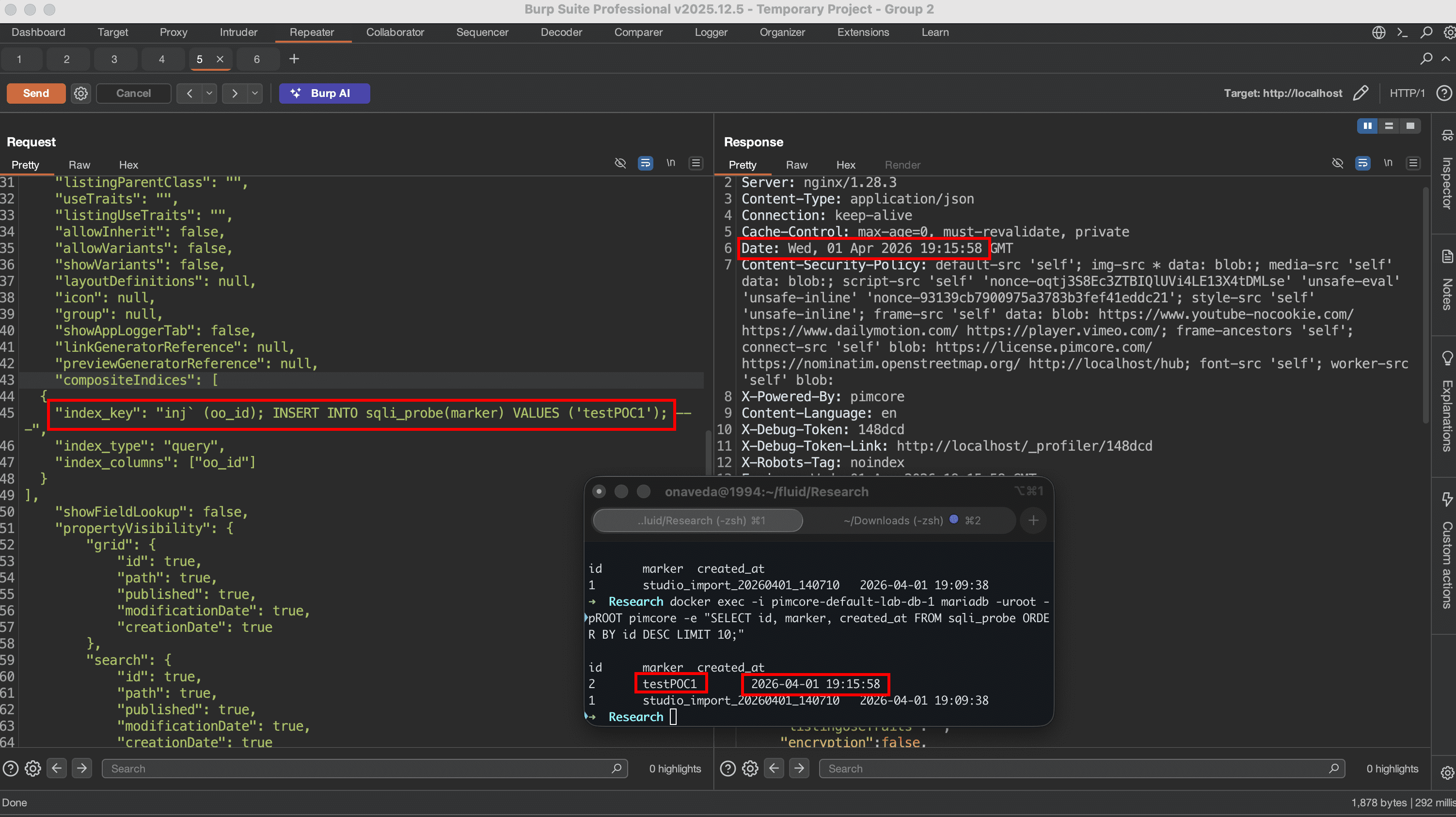
Evidence of Exploitation
Video of exploitation:
Static evidence:
Our security policy
We have reserved the ID CVE-2026-5394 to refer to this issue from now on.
System Information
Vendor Context
Pimcore is an open-core data and experience management platform used to centralize and manage digital business data across several domains, including Product Information Management (PIM), Master Data Management (MDM), Customer Data Platform (CDP), Digital Asset Management (DAM), Digital Experience/CMS, and digital commerce. Its core framework is built on top of the Symfony PHP framework and is designed to provide a flexible foundation for modeling, storing, and exposing structured and unstructured data.
Technical Information
Pimcore Platform
Version v12.3.3
Operating System: Any
References
Github Repository: https://github.com/pimcore/pimcore
Mitigation
An updated version of Pimcore is available at the vendor page.
Patch Review
The patch correctly addresses the root cause of the SQL injection by hardening both places where composite index metadata became SQL syntax: the index name and the indexed column list.
In the vulnerable implementation, compositeIndices values imported from class-definition JSON were treated as trusted schema metadata. The backend accepted attacker-controlled index_key and index_columns , then later concatenated them into ALTER TABLE statements used to add or drop indexes. The most reliable injection point was index_columns , because column names were joined into a raw SQL fragment and placed directly inside ADD INDEX (...) .
The patch mitigates this through two complementary changes: validating identifiers before they reach the SQL-building logic, and quoting every identifier at the SQL sink.
Composite Index Identifiers Are Now Validated
The patched code validates the composite index key when composite indexes are assigned:
This prevents malicious index names from being stored as part of the class definition metadata. The DAO also validates the index key again before updating the schema:
More importantly, the patch validates each indexed column before the column list is used in SQL:
The validation routine restricts identifiers to a safe format:
This blocks payloads containing SQL syntax characters such as spaces, commas, parentheses, backticks, comment markers, or additional DDL clauses. For example, a payload like:
can no longer pass validation, because it contains characters outside the accepted identifier pattern.
SQL Identifier Quoting Is Applied at the Sink
The patch also replaces unsafe SQL construction with contextual identifier quoting. Instead of inserting a raw column list into the query, the patched code quotes the table name first:
It then quotes every indexed column individually:
Finally, it quotes the index key when building the ADD INDEX statement:
This is the key security improvement. The vulnerable behavior was not only that the values lacked validation, but that user-controlled strings were allowed to become SQL structure. In the patched version, each value is treated as an SQL identifier, not as executable SQL syntax.
Credits
The vulnerability was discovered by Oscar Naveda from Fluid Attacks' Offensive Team using the AI SAST Scanner.
Timeline
Vulnerability discovered
Vendor contacted
Vulnerability patched
Public disclosure
Does your application use this vulnerable software?
During our free trial, our tools assess your application, identify vulnerabilities, and provide recommendations for their remediation.